Showing posts with label Getaround. Show all posts

Saturday, March 31, 2012

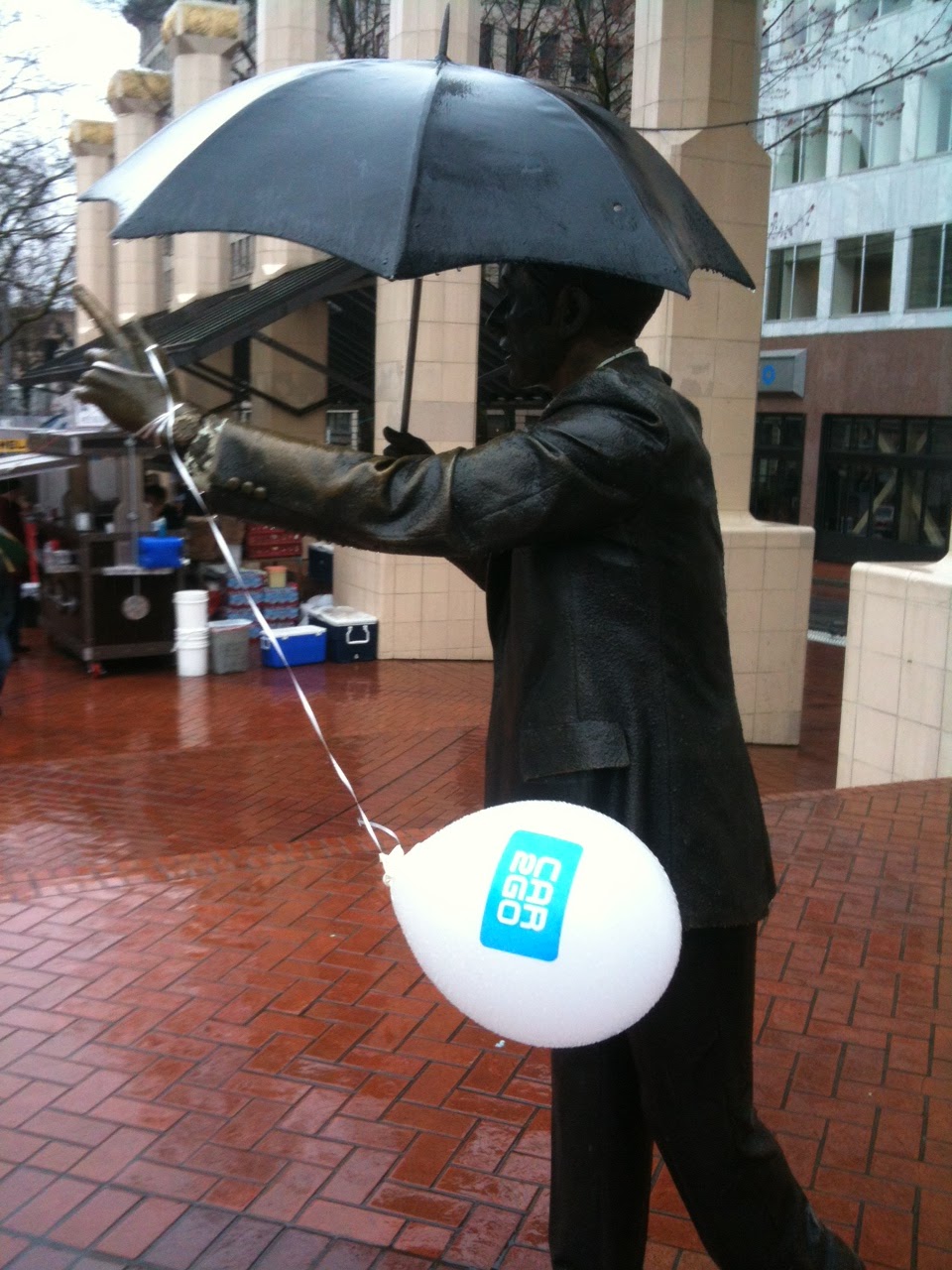
Car2Go launches in Portland

I took my first trip in a Portland car2go vehicle this wet morning — a 10 minute trip from NW Portland over to my house in NE Portland.  Given the weather it was probably the least auspicious launch of any car2go city.  But by noon at least the rain had stopped and people were venturing out of the houses and condos and coming downtown.

Yes I could have done the trip by transit — 44 minutes by bus with one transfer (and we have frequent service) — or 22 minutes by bicycle, but I was soaked and, besides I had this brand new car2go membership cards that was itching to be used.

Portland must now hold some sort of record for the most number of carsharing vehicles per capita — a little over 700 vehicles from the 3 companies — Zipcar, Getaround and now car2go — for 500,000 people in the city.  With 3 services, each with slightly different niches, the choices to go car-lite or even car free have never been greater.


What are the niches for Zipcar, Getaround and car2go? This is my take:
  •  Zipcar is the premium brand for reservation-based, round-trip carsharing.  They've got a wide variety of new and late model cars, pickups and minivans.  The cars are parked throughout the close-in neighborhoods and, for regular users, they've got some membership plans that bring the cost down.
  • Getaround, the peer to peer carsharing option for reservation-based round-trips has slightly older vehicles (none older than 1995) in an almost infinite variety of types, with the older vehicles at considerable discount over Zipcar, making them the affordable carshare choice.  Accessing the fleet is a bit more complicated since you have to request most vehicles from the owner via text message and you may have to meet them to exchange the keys (depending on how they've set up their Carkit.  (It's worth noting that both Relayrides and Just Share It also have a few vehicles listed in Portland.)  
  • Car2go, of course, is on-demand carsharing with floating parking anywhere in a large (but not quite large enough) "home zone" + one-way trip option.  As long as a Smart car will get you and a friend to your destination it's an amazing service.  And, I think it will likely transform many peoples' trip habits as they get familiar with it.
I've put together a table comparing the services here.

One local, long-time industry observer (not me) predicts that zero car households in the close-in neighborhoods could be greater than 50% in the next few years — that's a long way from the current 16% we are now.  Of course that won't be solely because of carsharing — Portland has done many things right over the past 20 years — density, walkable neighborhoods, good transit.  And, it looks like we'll even get public bikesharing sometime soon!

And if you're interested in what infrastructure is conducive for households to actually start lowering their vehicle ownership, transportation planner Jarrett Walker has written a very interesting piece about it.  He thinks Portland has many of the right factors in place, even though we are not even in the top 50 cities for low car ownership.

So, I welcome car2go to Portland.  You're in good company here.  And thanks for the free coffee and Honkin' Huge Burrito (from one of Portland original food carts) this morning, too.

Saturday, April 02, 2011

The difference between car sharing and car rental


In light of several new innovations in shared vehicle services, I think it is useful to review what the essential elements of carsharing are.  And why I consider some services, often referred to as carsharing, are actually car rental.

The simplest description of carsharing that I can come up with is this:
  • Unit pricing that includes fuel and insurance
  • Unattended access to the vehicle at trip start and end
Yes, there are other characteristics of current carsharing services - membership, parking, etc. but they aren't what make carsharing distinctive.   This means that Whipcar, and now Buzzcar, don't meet a key aspect of my definition - unattended access - since both require some sort key exchange.  And for what it's worth, at the present time two current P2P start ups in the US - Getaround and Relayrides appear to have 2 classes of vehicles in the fleet - those with technology and those without.  Of course, this "unattended access" could be easily provided with a simple mechanical lockbox mounted on a wall or post near the vehicle, as a number of carsharing companies have quite successfully employed over the years.

Another innovation that's gotten some press recently is the Peugeot Mu program.  While offering a wide range of vehicle types, it, also, does not meet my definition of true carsharing since (correct me if I'm wrong someone) members have to collect the vehicle keys in person.

Why is this important?

Don't get me wrong, I think car rental serves a useful function and p2p car rental, such as Whipcar, even more so (since it uses existing vehicles more efficiently and provides a gateway into shared vehicles for die-hard "can't pry my hands off the steering wheel" car owners).

The reason I think it's important to make the distinction between carsharing and car rental is because there is a large body of research that demonstrates substantial benefits to individuals, to cities and to the environment when people join and use carsharing - fewer cars, lower VMT, etc.  I would suspect that car rental might be able to demonstrate some of these benefits, although probably to a much smaller degree, but so far these companies have not commissioned any independent studies to validate their impact.  Until the benefits of other service models are quantified, I believe it is important that cities not extend privileges, such as marketing partnership, parking benefits, etc. that have been earned by carsharing.

Sunday, May 09, 2010

The other next big thing: Peer to Peer Carsharing (updated)

(This posting has been updated 10-1-2010 to reflect new information.)

A couple of months ago I had in mind 2 "next big things" - car2go and peer to peer (p2p) carsharing.  I've held off writing about p2p in anticipation that RelayRides would go live and I could talk about it as it actually works not as a hypothetical.  (Full disclosure, I'm consulting with RelayRides.)

Since then p2p carsharing and car rental has been all over the internet — Spride, Gettaround and Go-Op in the US; Whipcar and Wombat Car Club in the UK.  For what it's worth, there's a parallel movement to peer to peer car rental going on, as well — Spagg (apparently now defunct) may have been an example, and there are similar p2p car rental companies in Germany and Australia.)

What is peer to peer carsharing?  It's traditional carsharing using privately owned vehicles temporarily made available to a carsharing company for others to drive.  Like traditional carsharing the vehicles are decentralized, they're available by the hour, and they include gas and insurance in the rates (ideally full insurance coverage, not state minimum coverage).

But first, a point of clarification: some of the services that claim to be carsharing don't actually meet what I would call the minimum requirements for calling themselves carsharing — most importantly lacking "unattended access", through a lockbox or electronic technology.  If you've got to meet the owner to exchange keys at the beginning and end of the trip I just don't see how that will provide sufficient convenience of access for drivers.

Here's why I think unattended access important: if you want to  claim to be carsharing I want to be sure it will deliver the benefits that so many of us have worked so hard to establish over the years — fewer cars on the road, fewer parked cars, VMT reductions, increased use of transit, bicycling and walking. If not, why should local governments support carsharing?   Car rental, even so-called hourly car rental, has never demonstrated these benefits.

Because of the lack of unattended access, in my mind, this excludes Whipcar as real carsharing at the present time.  Fortunately, the major players all appear to be talking about some sort of technology, so, by my definition RelayRides, Spride, Gettaround and Go-Op are bona fide peer to peer carsharing services.  (Caveat, the functionality of the technology offered by each service could be significantly different.  )

Why is peer to peer so attractive?  

Well, it's certainly a good deal for car owners, who can easily make several thousand dollars a year from their car ("Don't work for your car, make your car work for you," as Spride says.)  Need I say more?

For the carsharing member (driver or renter in p2p terms), some adjustments will be necessary — it seems likely that in most cases instead of knowing a couple of favorite vehicle locations near your home or office, you'll have to go on the internet (or ideally smart phone) to locate the cars that are available during the timer period you have in mind; and there may be a little anxiety finding the location the first time, particularly in cities.

For the carsharing company it transforms a major expense (leasing or owning the fleet) into a variable cost that they only pay when the car is actually making money.  And, the lower cost structure means that carsharing can be feasible in less dense, more suburban locations (i.e. lower hours per day utilization), increasing the benefits of carsharing beyond the center city and close-in neighborhoods of the relatively few cities in the US that presently have carsharing.  That's the heart of why I think is peer to peer a next big thing.  

A side benefit of p2p is that, in the same way that using carsharing instead of owning a car (or 2) can be a transition to car-lite lifestyle, renting a car out to others may also serve as a transition to a car-lite lifestyle for vehicle owners.  

Why now?

Until now the hangup in getting peer to peer off the ground has been insurance. The issue has been figuring out whether there's an issue (and how to resolve it, if there is) about where/when the vehicle owner's personal auto insurance policy ends and the carsharing policy begins in the event of a claim.  Apparently, the economic climate has loosed up the insurance underwriters' grips on the reins at insurance companies.  (Whatever it takes, I guess...)

Another reason may be the explosion of interest in the iPhone and smart phones in general, which I think will make finding and booking p2p vehicles much easier and more spontaneious than having to log on to a carsharing company web site at home or work.  And, no doubt, the down turn in the economy got the juices flowing with all sort of unorthodox start ups.

Finally, in this survey of peer to peer carsharing, I would be remiss not mention the unsung pioneer in the peer to peer carsharing world: a little community car club in the UK with the unlikely name of Wombat Car Club.  They figured out the insurance years ahead of anyone else and have a very generous payment plan for car owners.  Thanks for leading the way.